Rose curves
How to graph a rose curve
One short equation, and a flower appears. The only tricky part is knowing how many petals you are going to get before you draw a single one.
A rose curve is any polar equation of the form r = a·cos(nθ) or r = a·sin(nθ). Change n by one and the whole flower reorganises itself, sometimes doubling its petal count in the process.
This guide takes you through the four steps to graph one by hand: petal length, petal count, where the first petal sits, and plotting it. If you would rather see it move than read about it, the polar graphing calculator draws any of these instantly.
Each petal reaches |a| units from the origin. For the petal count, look at n: if n is odd you get n petals, and if n is even you get 2n. So r = 2cos(5θ) draws 5 petals and r = 2cos(4θ) draws 8.
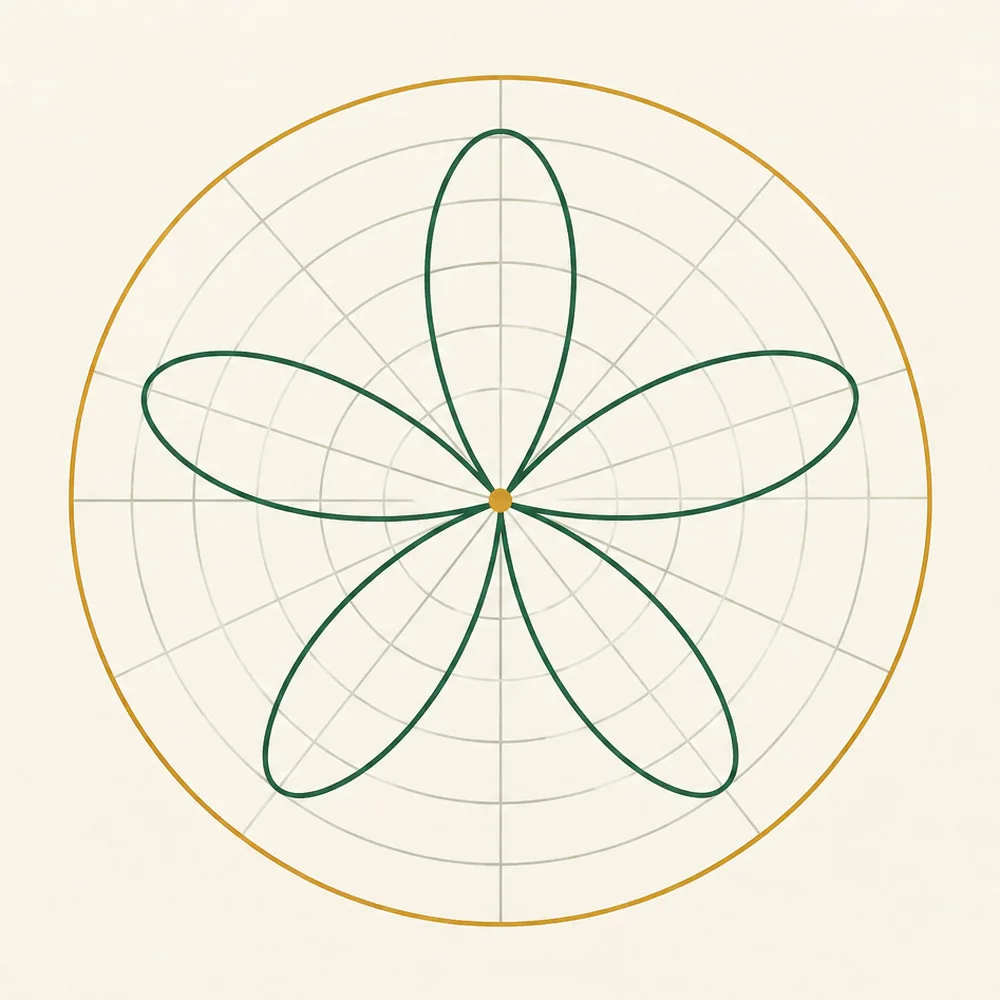
The basics
What a rose curve actually is
In polar coordinates you do not plot x and y. You plot a distance r from the origin at an angle θ. As θ sweeps around the circle, r grows and shrinks, and the pen traces a shape.
A rose happens when r is a cosine or sine of a multiple of θ. Because cosine and sine swing between −1 and 1, r keeps reaching out to |a| and falling back to zero. Every swing out and back draws one petal. A rose curve is just a wave, drawn in a circle instead of a straight line — and n controls how many times that wave completes per rotation.
Step 1
Read a to get the petal length
The coefficient in front tells you how far each petal reaches. Petal length = |a|.
In r = 2cos(4θ) every petal extends 2 units from the origin. In r = 5sin(3θ) every petal extends 5.
The absolute value matters. A negative a does not shrink the petals or turn them inside out — it rotates the whole rose. The petals are still |a| long.
Step 2
Read n to get the petal count
This is the step that costs marks. The rule looks backwards, because the even number gives you more petals.
n odd → n petals. r = 2sin(5θ) gives 5.
n even → 2n petals. r = 2cos(4θ) gives 8.
The short version of why: with an odd n the curve finishes the whole figure in half a rotation and then retraces it, so the second half adds nothing. With an even n nothing overlaps, so the second half contributes a fresh set of petals in the gaps. The polar graphing guide walks through the tracing in more detail, alongside the other curve families.
Step 3
Find where the first petal sits
A petal is centred where r reaches its maximum and pinched shut where r = 0. Finding those zeros tells you exactly where each petal starts and ends.
For r = a cos(nθ), set cos(nθ) = 0. Cosine is zero at π/2, so:
A shortcut worth keeping: whatever the petal count p turns out to be, the petals are evenly spaced around the full circle, so they sit 2π/p apart.
Step 4
Plot it
Take r = 2cos(4θ). From the three steps above: a = 2 so each petal is 2 units long; n = 4 is even so there are 8 petals; the first zero is at π/8 and the petals sit π/4 apart.
Now step θ through the first petal and watch what r does.
| θ | 4θ | cos(4θ) | r |
|---|---|---|---|
0 | 0 | 1 | 2 |
π/16 | π/4 | 0.707 | 1.41 |
π/8 | π/2 | 0 | 0 |
3π/16 | 3π/4 | −0.707 | −1.41 |
π/4 | π | −1 | −2 |
Plot those in order and the first petal appears. The negative values at the end are not a mistake — a negative radius plots in the opposite direction, which is exactly how the next petal begins forming across the origin. Carry on around the circle and all eight fill in.
Type the equation into the polar graphing calculator and change the 4 to a 5. Watching the petal count drop from eight to five makes the odd–even rule stick far faster than reading it does.
The common mix-up
cos versus sin: same rose, rotated
r = 2cos(3θ) and r = 2sin(3θ) produce the identical shape. Same petal count, same petal length. The only difference is rotation.
The cosine version has a petal centred on the polar axis at θ = 0. The sine version is turned by π/(2n), so for n = 3 that is a rotation of π/6, or 30°. If a question asks for a sine rose and you have only practised cosine ones, draw the cosine version and rotate it.
At a glance
Common rose curves
| Equation | n | Odd or even | Petals | Petal length |
|---|---|---|---|---|
r = 3cos(2θ) | 2 | even | 4 | 3 |
r = 3cos(3θ) | 3 | odd | 3 | 3 |
r = 2sin(4θ) | 4 | even | 8 | 2 |
r = 2sin(5θ) | 5 | odd | 5 | 2 |
r = 4cos(6θ) | 6 | even | 12 | 4 |
r = 4cos(7θ) | 7 | odd | 7 | 4 |
The petal column jumps around rather than climbing steadily, because every even n doubles and every odd n does not. Which gives you a free check: a rose with an odd number of petals can only have come from an odd n.
Watch out
Common mistakes
The most frequent error by a distance. Check whether n is odd or even before you count anything.
If your working is in radians and the calculator is set to degrees, every value comes out wrong and the shape looks like nonsense. Check the DEG/RAD toggle first.
It is not. A negative radius plots in the opposite direction, and that is precisely the mechanism that produces the extra petals when n is even.
If n is something like 3/2 the odd–even rule does not apply. The curve needs more than one full rotation to close, and some never close at all. Plot those rather than predicting them.
Questions
Rose curve FAQ
How many petals does a rose curve have?
If n is odd you get n petals; if n is even you get 2n. So r = cos(7θ) has 7 and r = cos(6θ) has 12.
How long are the petals?
Every petal reaches |a| units from the origin, where a is the coefficient in front of the cosine or sine. A negative a rotates the rose rather than shortening it.
What is the difference between r = a cos(nθ) and r = a sin(nθ)?
Nothing except rotation. Same shape, same petal count, same petal length. The sine version is turned by π/(2n) relative to the cosine version.
Where does the first petal close?
Set cos(nθ) = 0, which gives θ = π/(2n). For r = 2cos(4θ) that is π/8, so the petal spans π/4 in total.
Can n be a fraction or a decimal?
Yes, but the odd–even rule stops working. Fractional values need several rotations before the curve closes, and irrational ones never close at all. Graph those rather than predicting them.
Why is it called a rose curve?
The petals arranged around a central origin look like a flower seen from above. You will also see them called rhodonea curves, from the Greek word for rose.
Keep exploring
Related tools and guides
Polar graphing guide
The full picture: circles, cardioids, limaçons, lemniscates and spirals, plus converting between polar and rectangular form.
Read the polar graphing guideScientific calculator
Work out the cosine values behind your table, and switch between degrees and radians before you start.
Open the online scientific calculatorBrowse everything in all calculator guides, or jump straight into the free polar graphing calculator.
Grow a flower in one line of maths
Type r = 2cos(4θ), then change the 4 and watch the petals reorganise themselves in real time.